




Window Glass Replacement in Nesconset, NY
A skylight that has gone opaque is not providing light. It is providing a heat trap, an aesthetic disappointment, and — if the IGU seal has failed — a potential water infiltration path every time it rains. This Nesconset homeowner had reached the point where the skylight was contributing nothing to the room below in terms of natural light and was beginning to raise questions about its integrity as part of the roof envelope. The bronze aluminium frame was structurally sound. The glass was not.
The correct response to a skylight in this condition is not skylight replacement — it is skylight glass replacement. The frame, the frame seals, the mounting hardware, and the relationship between the skylight unit and the roof opening are all components that do not need to change when only the glass has failed. We removed the glass panel, replaced it with a correctly specified new IGU unit, and reinstalled the skylight with the same bronze frame that was there before. The homeowner in Nesconset now has a skylight that functions as a skylight should.
What the Before Photo Shows — Understanding Skylight Glass Failure
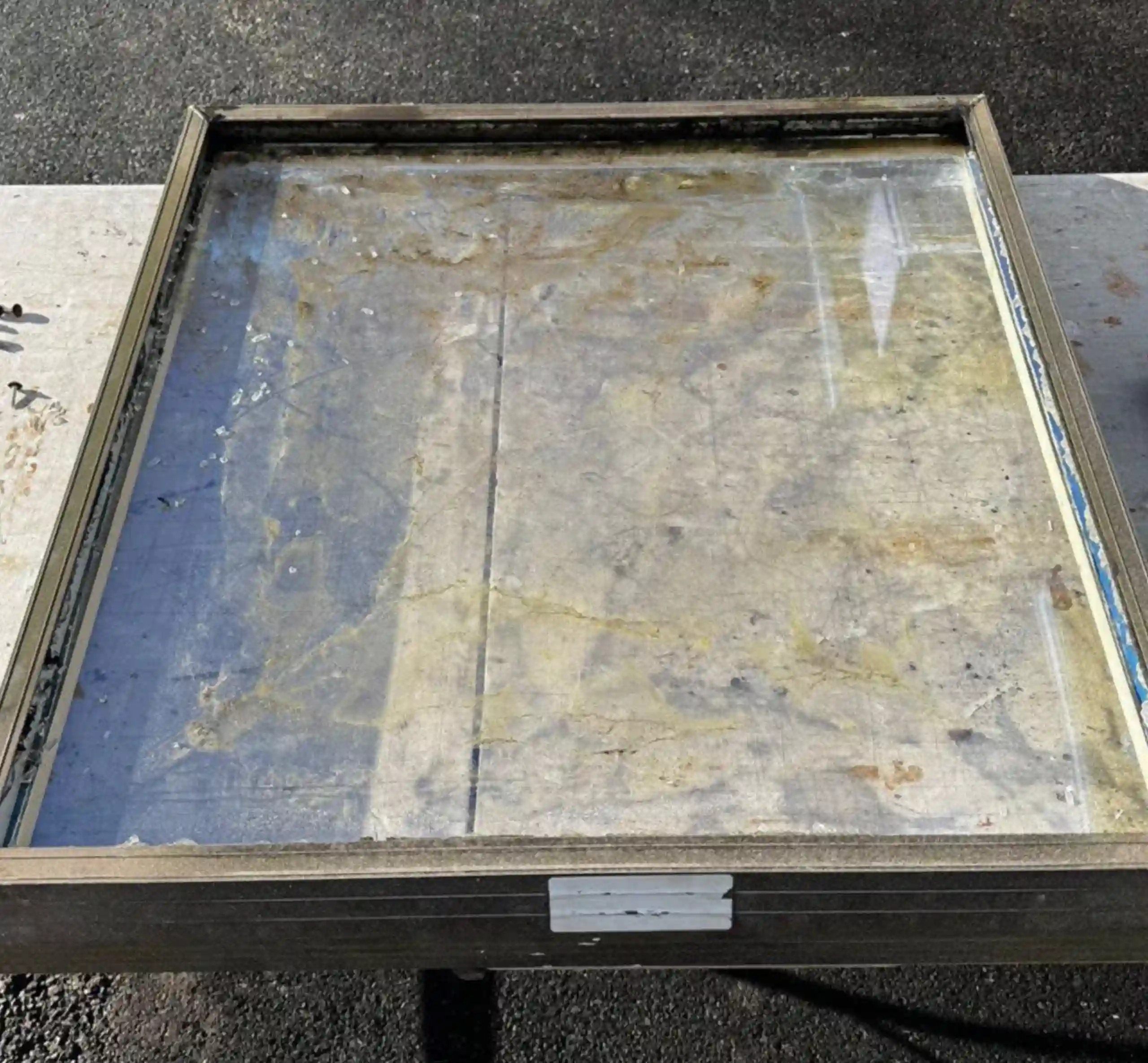
The before photo is taken from above, looking down at the removed skylight unit lying flat on a driveway surface. The bronze aluminium frame is clearly intact — clean profile, functioning latch hardware at the bottom edge — but the glass panel it surrounds is in a state of severe degradation.
The contamination visible in the before glass is not surface grime that could be cleaned. It is the result of multiple failure processes operating simultaneously over an extended period:
IGU seal failure and internal contamination. The yellowing and the banded staining pattern visible across the glass surface are characteristic of a failed insulated glass unit seal — atmospheric moisture has entered the space between the two glass layers and deposited mineral residue on the inner glass surfaces over many years of cycling. Unlike the uniform internal fogging of a freshly-failed IGU seal, this level of staining indicates the seal had been failing for a long period, with mineral deposits accumulating in layers on the inner glass faces. This contamination cannot be cleaned because it is between the glass panes, fully enclosed by the failed but still-intact edge bond.
UV degradation of the inner sealant. Skylights receive significantly more direct UV exposure than vertical windows — sun angles at mid-day drive UV intensity through a horizontal glass surface at a rate that vertical windows never experience. The inner sealant materials of an IGU that receives this exposure degrade faster than the equivalent vertical installation, which is why skylight IGU seals have shorter effective lifespans than wall-mounted window IGU seals in otherwise identical installations.
Organic and mineral deposit accumulation. The brownish-orange deposits in the before photo are consistent with iron-rich mineral compounds — common in Long Island’s groundwater, which is among the most mineral-rich in the northeast due to the glacial aquifer system underlying the island. When water from condensation or minor infiltration contacts these deposits over years, the staining becomes a permanent feature of the glass surface.
The result is a glass panel that transmits essentially no useful light to the room below — defeating the entire functional purpose of the skylight.
Why the Frame Was Worth Keeping
Before any skylight glass replacement begins, the correct assessment is of the frame — not the glass. The glass is what has failed, but if the frame has also deteriorated to a point of structural or sealing compromise, replacing only the glass extends the frame’s life without addressing the real problem.
This Nesconset skylight had a bronze aluminium frame in sound structural condition. The frame profile showed no distortion or corrosion at the joints. The latch hardware was functional. The frame-to-roof seal, while due for recaulking, showed no evidence of active water infiltration into the roof structure. The mounting system was intact. None of these components needed replacement — which meant the entire cost and disruption of fitting a new skylight unit and integrating it into the existing roof opening could be avoided entirely.
Our glass replacement service covers skylight applications alongside all standard window types. The principle is the same as any IGU replacement: measure the opening precisely, source the correctly-specified glass unit, install it correctly within the existing frame, and seal the installation against the environment the glass faces. For a skylight, “the environment it faces” means direct UV exposure, thermal cycling from extreme temperature differentials, and the hydrostatic pressure of standing water on a horizontal glass surface after rain — all of which require a correctly-specified IGU with the appropriate glass type and edge seal system for a horizontal application.
The Replacement — From Contaminated to Clear
Removal of the Failed IGU
The skylight unit was removed from the roof mounting and brought to ground level — the before photo captures it at this stage, lying flat on the driveway. Servicing the glass at ground level rather than on the roof is standard practice for a skylight of this size: it allows precise measurement of the glass opening without the constraints of working on a roof surface, ensures the new glass unit can be handled safely during installation, and allows the frame channel to be properly cleaned and prepared before the new unit is seated.
The failed IGU was removed from the bronze frame channel, the glazing tape and sealant residue were cleaned from the channel surfaces, and the frame opening was measured precisely for the replacement unit.
Glass Specification for Horizontal Applications
Skylight glass operates under fundamentally different loads than vertical window glass — the glass specification must reflect this. A horizontal glass installation is subject to deflection under its own weight, hydrostatic pressure from standing water, and thermal stress from the extreme temperature differentials between a sun-exposed upper surface and a conditioned interior below. The replacement IGU for this Nesconset project was specified with the appropriate glass thickness and tempered safety construction for a horizontal application — not a standard residential IGU of the type used in a vertical window. Our glass cutting and sourcing capability covers specialty glass specifications including horizontal skylight applications, laminated safety glass, and non-standard dimensions.
Installation and Frame Resealing
The new IGU was seated in the bronze frame channel with correctly specified glazing tape and sealant for a horizontal application. The perimeter frame seals — the junction between the skylight frame and the surrounding roof — were cleaned and resealed with exterior-grade roofing-compatible sealant as part of our standard window recaulking process. The unit was reinstalled in the roof opening, hardware checked, and the installation tested for correct closure and seal contact before the job was closed out.
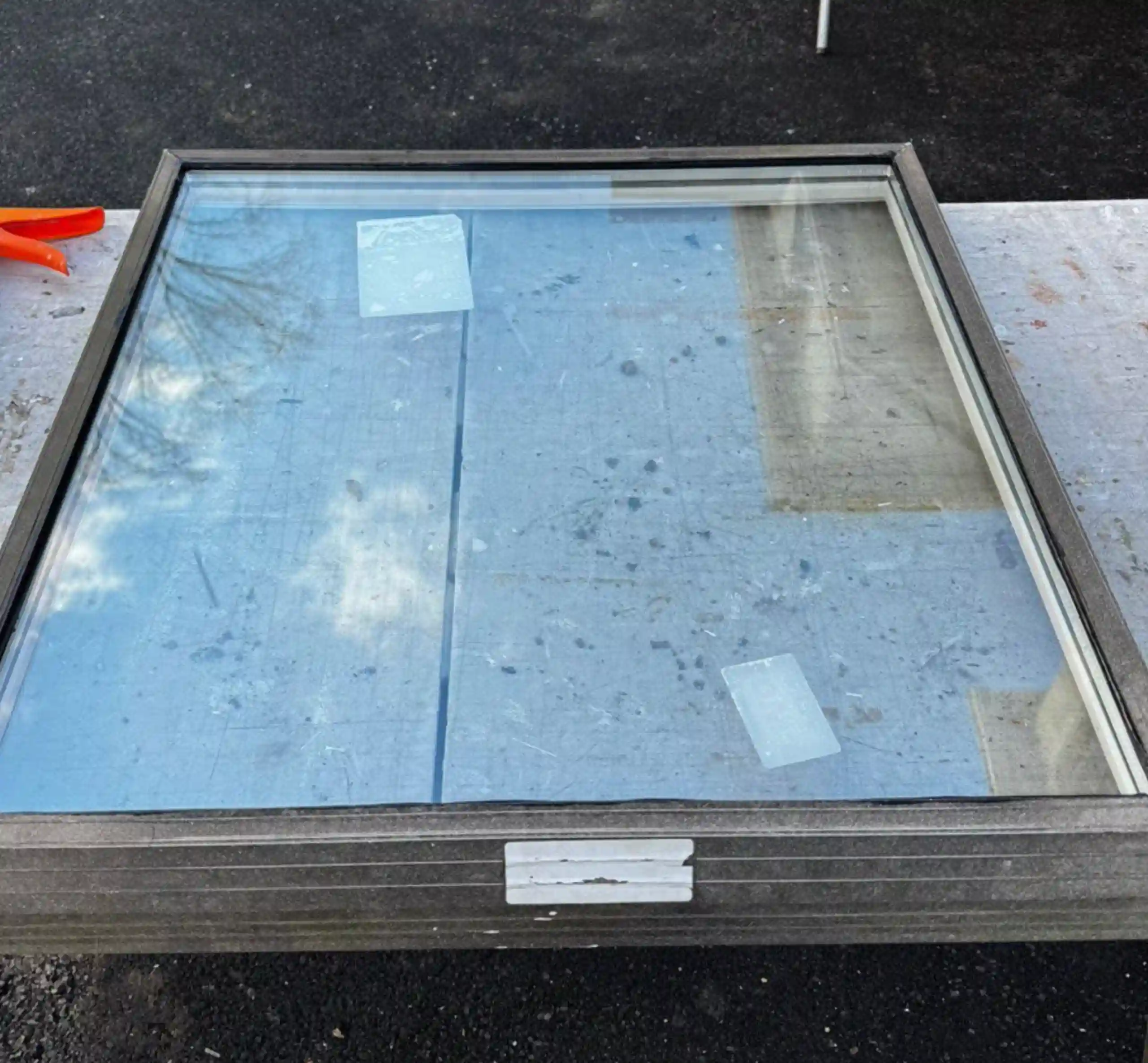
The after photo — the protective blue film still on the new glass — captures the skylight immediately after the new unit was installed. The sky visible through the glass in the after photo was completely invisible through the before glass.
Skylights Replacement on Long Island, NY Explained
Long Island’s climate creates specific conditions that accelerate skylight IGU seal degradation beyond what manufacturers’ lifespan estimates — which are typically based on vertical installation performance — would suggest.
The combination of Long Island’s humid summers, cold winters, and high UV index on south and west-facing roof slopes drives thermal cycling in horizontal glass installations at an intensity that vertical windows rarely experience. A skylight on a south-facing roof in Nesconset or anywhere in central Suffolk County can reach internal frame temperatures of 140–160°F on a clear summer day, then drop to near-freezing on a winter night. The edge seal of an IGU is a flexible adhesive system that is expanding and contracting with every one of those cycles — and it degrades faster under that cycling frequency than the equivalent seal in a wall-mounted window.
The practical implication for Long Island homeowners is that skylights installed at the same time as the windows in a home will typically fail before the windows do — and the failure, when it comes, is dramatic. A wall window with a failed IGU seal looks foggy. A skylight with a failed IGU seal, exposed to years of UV and thermal cycling, looks like the before photo in this Nesconset project.
We serve skylight glass replacement requests throughout central Suffolk County from our Hauppauge office. Homeowners in Nesconset, Smithtown, Lake Grove, St. James, and Commack searching for skylight glass replacement in Nesconset, NY or anywhere in the Smithtown area can reach us at 516-908-8005.
Related Services on Skylight and Roof Window Projects
The Nesconset skylight project drew primarily on our glass replacement, glass cutting, and recaulking services. Alongside skylight glass replacement, related work we assess and complete on the same visit includes:
Sunroom window repair — sunroom roof glass panels and skylights share the same horizontal glass failure patterns and are assessed using the same approach
Window glass replacement — when skylights and standard windows in the same home have both reached IGU failure simultaneously, we complete the full scope in a single visit
Wood window and door repair — wooden skylight curb or frame sections that show moisture damage from a long-failed skylight seal assessed and addressed before the new glass is installed

Ground-Level Servicing
We remove the skylight unit from the roof for ground-level glass service where possible — allowing precise measurement, safe glass handling, and proper frame channel preparation that is not achievable when working entirely on a roof surface.
Perimeter Resealed at Every Job
The frame-to-roof perimeter seal is recaulked as standard on every skylight glass replacement — because a correctly installed new glass unit with a degraded perimeter seal is still a water infiltration risk at the next rain event.
Suffolk County From Hauppauge
Our Hauppauge office puts us at the centre of Suffolk County, with fast scheduling throughout Smithtown, Nesconset, Commack, Lake Grove, and surrounding central Long Island communities.
View our before and after photos


THE MOST POPULAR QUESTIONS
Looking for window and door repair or replacement services in Long Island?
Contact our team of on-site specialists for all your needs.
other services we provide
Rotten Window Repair
Rot won't stop spreading on its own — we remove it completely, rebuild the frame, and seal it for good. Dive in to learn more!
Side Light Glass Replacement
Cracked, broken, or foggy sidelight glass replaced professionally across Long Island, NY — learn more here!

Glass Cutting
Broken glass can pose a danger to others and also detract from the visual appeal of a house's exterior. However, it's not always necessary to order a new window to fix this situation.
Glass Replacement
Fast, professional glass replacement for homes and businesses across Long Island, NY.

Kitchen Cabinet Doors Adjustment
Perfect cabinet doors with Prestige Window Works' guide. From diagnosis to adjustment, discover techniques for harmonizing function and style. Transform your kitchen with our expertise.